M1 Finance Review 2026: Free Automated Investing with Customizable Portfolios
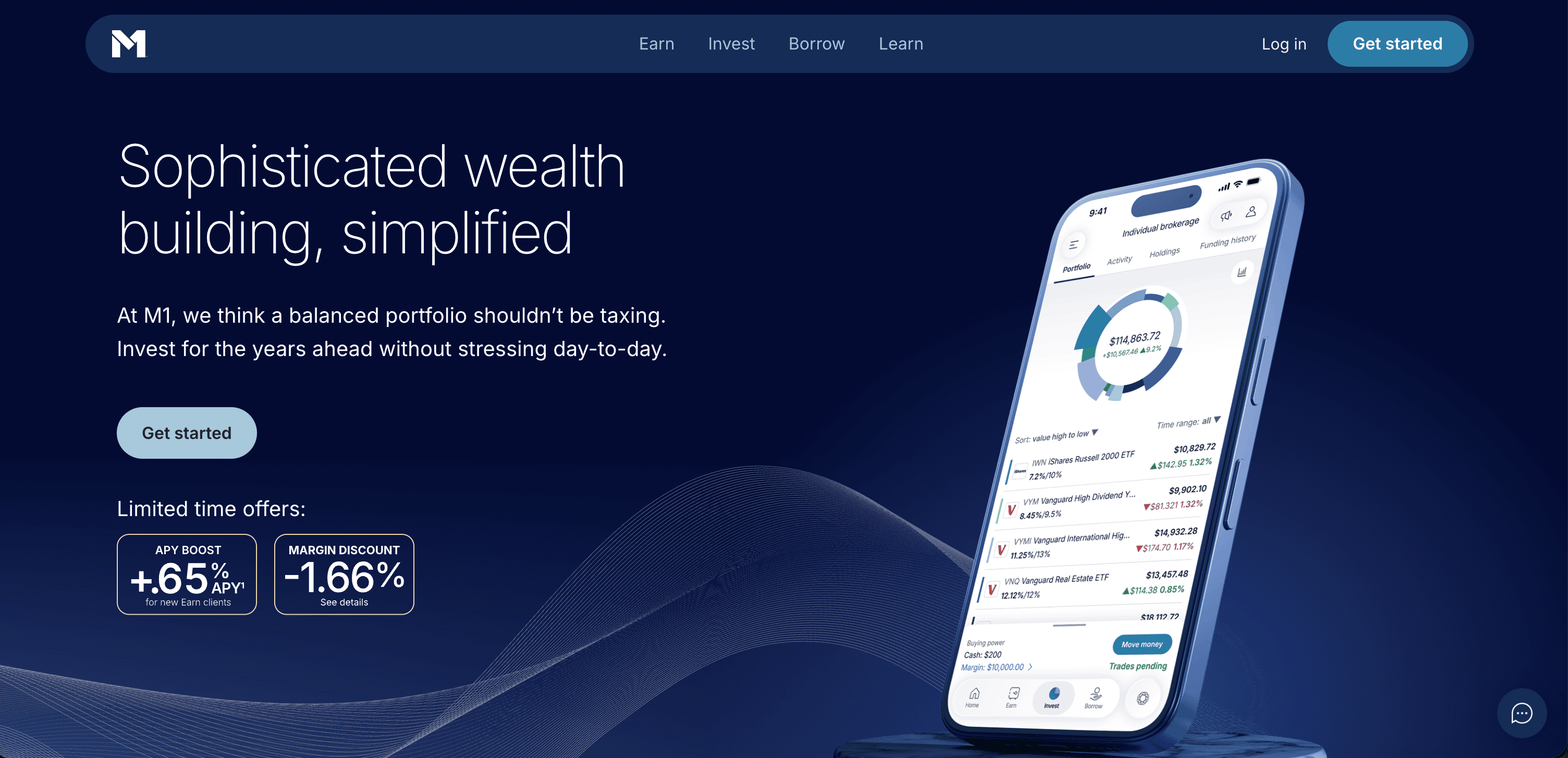
Quick Verdict
M1 Finance
M1 Finance is an excellent choice for hands-off investors who want the control of self-directed investing combined with automated portfolio management. Its unique Pie system, commission-free trading, and fractional shares make it ideal for long-term wealth building.
M1 Finance has carved out a unique niche in the investing world by combining the best features of robo-advisors and traditional brokerages. Unlike pure robo-advisors that make all decisions for you, or traditional brokers that require manual management, M1 lets you build custom portfolios that automatically maintain your target allocations.
In this comprehensive review, we'll examine whether M1 Finance lives up to its promise of making investing simple, automated, and free.
What is M1 Finance?
M1 Finance is a financial services company founded in 2015 that offers a hybrid investing platform combining self-directed brokerage features with automated portfolio management. The platform has grown to manage over $7 billion in assets for more than 500,000 users.
The company's flagship feature is the "Pie" system, which allows investors to create visual portfolio allocations and automate their investing strategy. M1 also offers M1 Spend (banking), M1 Borrow (margin loans), and M1 Plus (premium subscription) services.
How M1 Finance Works: The Pie System
The Pie system is what sets M1 Finance apart from competitors. Here's how it works:
Creating Your Pie
- Choose your investments - Select from over 6,000 stocks and ETFs
- Set target allocations - Assign percentage weights to each holding
- Fund your account - Deposit money via bank transfer
- Automatic investing - M1 buys fractional shares to match your targets
- Dynamic rebalancing - New deposits and dividends automatically maintain your allocation
Expert Pies
Don't want to build your own portfolio? M1 offers over 80 pre-built Expert Pies designed by financial professionals, including:
- General Investing - Diversified portfolios for different risk levels
- Retirement Planning - Target-date style portfolios
- Income Strategies - Dividend-focused allocations
- Responsible Investing - ESG and socially responsible options
- Hedge Fund Followers - Portfolios mimicking famous investors
M1 Finance Pricing and Plans
M1 Finance Pricing
M1 Basic
- Commission-free trading
- Fractional shares
- Automated investing
- Dynamic rebalancing
- 80+ Expert Pies
- 1 trading window per day
- M1 Borrow at 6.75% APR
- Basic M1 Spend account
M1 Plus
- Everything in Basic
- 2 trading windows per day
- M1 Borrow at 4.75% APR
- 1% APY on M1 Spend
- 1% cash back on purchases
- Smart Transfers automation
- Priority customer support
- Custodial accounts
💡M1 Plus is worth it if you use M1 Borrow or want the extra trading window
Key Features Deep Dive
Fractional Shares
M1 Finance allows you to invest in fractional shares with as little as $1. This means you can own a piece of expensive stocks like Amazon or Google without needing thousands of dollars. Fractional shares also ensure that 100% of your money is always invested rather than sitting idle.
Automated Rebalancing
Unlike traditional brokerages where you must manually rebalance, M1 uses "dynamic rebalancing" to maintain your target allocations. When you deposit money or reinvest dividends, M1 automatically purchases underweight positions first. This keeps your portfolio aligned without triggering taxable events from selling.
M1 Borrow
M1 Borrow lets you take out a margin loan against your portfolio at competitive rates:
- M1 Basic: 6.75% APR
- M1 Plus: 4.75% APR
You can borrow up to 35% of your taxable portfolio value with no application or origination fees. This can be useful for large purchases while keeping your investments intact.
M1 Spend
M1 Spend is an integrated checking account that works seamlessly with your investment account. Features include:
- FDIC insured up to $5 million
- No monthly fees or minimum balance
- Free ATM access at 75,000+ locations
- Direct deposit up to 2 days early
- M1 Plus members earn 1% APY and 1% cash back
Smart Transfers
M1 Plus members get access to Smart Transfers, which automate money movement between accounts based on rules you set. For example, you can automatically invest any checking balance above $1,000, creating a seamless savings and investing system.
Pros and Cons
Pros
- Commission-free stock and ETF trading with no hidden fees
- Unique Pie system makes portfolio building visual and intuitive
- Fractional shares allow investing with any amount
- Automated rebalancing keeps your portfolio on target
- Integrated banking with M1 Spend checking account
- Competitive margin rates with M1 Borrow
- Over 80 pre-built Expert Pies for hands-off investors
- No account minimums for basic accounts
- Clean, user-friendly mobile app and web interface
Cons
- Only one trading window per day (two with M1 Plus)
- No tax-loss harvesting feature
- Cannot trade mutual funds, bonds, or options
- Limited research tools and market analysis
- No human financial advisors available
- Customer support can be slow to respond
- Minimum $100 to start investing ($500 for IRAs)
- No real-time trading for active investors
M1 Finance vs Alternatives
M1 Finance vs Fidelity
Fidelity offers more investment options including mutual funds, bonds, and options trading, plus robust research tools. However, M1's automated Pie system and visual portfolio building make it easier for hands-off investors. Choose Fidelity if you want comprehensive research; choose M1 if you prefer automated portfolio management.
M1 Finance vs Robinhood
Both offer commission-free trading, but they serve different purposes. Robinhood is designed for active traders with real-time execution, options, and crypto. M1 is built for long-term investors who want automated, set-it-and-forget-it investing. Robinhood for trading; M1 for investing.
M1 Finance vs Betterment
Betterment is a pure robo-advisor that builds and manages your portfolio entirely. M1 gives you more control over your investments while still automating the execution. Betterment includes tax-loss harvesting; M1 does not. Choose Betterment for fully hands-off investing; M1 if you want to pick your own investments.
M1 Finance vs Schwab
Schwab offers a broader range of products and services including physical branches, full-service banking, and human advisors. M1 wins on automation and the Pie system. Schwab is better for those who want a traditional full-service brokerage; M1 is better for tech-savvy investors who prefer digital-first experiences.
Who Should Use M1 Finance?
M1 Finance is ideal for:
- Long-term investors who want automated portfolio management
- DIY investors who want to build custom portfolios without constant monitoring
- Beginners who want guided investing through Expert Pies
- Investors looking to consolidate banking and investing in one platform
- Those who want to invest with small amounts using fractional shares
M1 Finance may not be right for:
- Active day traders who need real-time execution
- Investors who want access to mutual funds, bonds, or options
- Those who need comprehensive research and analysis tools
- Investors who want tax-loss harvesting automation
- People who prefer human financial advisors
Account Types Available
M1 Finance supports a variety of account types:
- Individual taxable accounts
- Joint taxable accounts
- Traditional IRA
- Roth IRA
- SEP IRA
- Rollover IRA
- Trust accounts
- Custodial accounts (M1 Plus only)
Getting Started with M1 Finance
- Sign up - Create your account in minutes
- Build your Pie - Choose investments or select an Expert Pie
- Fund your account - Link your bank and deposit funds
- Set up automation - Enable automatic deposits for consistent investing
- Let it grow - M1 handles the rest automatically
Security and Regulation
M1 Finance takes security seriously:
- SIPC Protection: Securities protected up to $500,000
- FDIC Insurance: M1 Spend deposits insured up to $5 million through partner banks
- SEC & FINRA Registered: Fully regulated brokerage
- Bank-level encryption: 4096-bit encryption for data protection
- Two-factor authentication: Optional additional security layer
Customer Support
M1 Finance offers customer support through:
- Email support for all users
- Phone support for M1 Plus members
- Comprehensive help center and FAQ
- In-app chat support
Response times can vary, with M1 Plus members receiving priority support. This is one area where M1 could improve, as some users report slow response times during peak periods.
Final Verdict
M1 Finance delivers on its promise of combining the best of robo-advisors and self-directed brokerages. The Pie system is genuinely innovative, making portfolio building visual and automated investing accessible to everyone. Commission-free trading, fractional shares, and integrated banking make it a compelling all-in-one financial platform.
The main drawbacks are the single daily trading window (limiting active traders) and lack of tax-loss harvesting. If you're a long-term investor who wants control over your investments without the hassle of constant management, M1 Finance is an excellent choice.
Rating: 4.6/5 - Excellent for automated, long-term investing with a unique approach to portfolio management.
Get Started with M1 FinanceDisclosure: We may receive compensation when you click on links to M1 Finance. This does not influence our ratings or reviews. See our affiliate disclosure for more information.
Further Reading
Disclaimer: This article is for informational purposes only and does not constitute financial advice, investment recommendations, or an endorsement of any particular security or strategy. Always conduct your own research and consult with a qualified financial advisor before making investment decisions. Past performance is not indicative of future results.
Enjoying this article? Get more like it.
No spam, unsubscribe anytime.
Written by
John SmithJohn is a financial analyst and investing educator with over 10 years of experience in the markets.